

Managed IT Services Pricing: What Should Small Businesses Expect to Pay in 2027?


For small businesses, technology is no longer just a supporting function. It powers daily operations, communication, customer service, cybersecurity, and long-term growth. However, maintaining reliable IT systems comes with expenses that can be difficult to predict without the right support structure.
That is why many businesses are researching managed IT services pricing before deciding whether to outsource their technology management.
Understanding how managed IT providers structure their fees, what services are included, and which factors influence costs can help businesses make more informed decisions. Rather than choosing the lowest quote, the goal should be finding an IT partner that delivers dependable support, security, and long-term value.
How Much Do Managed IT Services Cost?
Managed IT services pricing varies depending on business size, technology infrastructure, cybersecurity requirements, and the level of support provided.
For preliminary budgeting, businesses may encounter estimated rates of approximately $100 to $250 per user per month for comprehensive managed IT services. These figures are illustrative market estimates, not published pricing from Get IT Right Solutions, and actual quotes can fall outside this range.
For example, a company with 25 employees might use those estimates to develop an initial monthly IT budget of $2,500 to $6,250. However, that calculation does not necessarily include onboarding, equipment purchases, special projects, or advanced security requirements.
Businesses should request detailed proposals to understand exactly what their monthly investment covers.
Common Managed IT Services Pricing Models
Not every managed service provider (MSP) charges the same way. Understanding common pricing structures makes it easier to compare proposals.
Per-User Pricing
Under this model, businesses pay a monthly fee for each supported employee. Depending on the agreement, that fee may cover multiple devices assigned to the same person. Per-user pricing can be particularly attractive for businesses with employees who use laptops, desktops, smartphones, and other connected devices.
Per-Device Pricing
Some providers charge according to the number and type of devices they manage. Servers, workstations, networking equipment, and other infrastructure may have separate rates. This approach can work for organizations with predictable equipment inventories, although costs may increase as additional devices are introduced.
Flat-Rate Managed IT Pricing
Flat-rate agreements establish a recurring monthly fee for a defined collection of services.
This model can make technology expenses more predictable, especially when monitoring, maintenance, helpdesk assistance, and other essential services are included.
Get IT Right Solutions offers managed IT and support services designed to provide comprehensive technology management at predictable monthly rates.
Tiered Pricing
Tiered packages allow businesses to choose among different service levels. A basic package might include monitoring and maintenance, while higher tiers could provide broader cybersecurity protection, strategic planning, and expanded technical support. Businesses should carefully review each tier to avoid overlooking services they may eventually need.
What Is Included in Managed IT Services Pricing?
One of the biggest mistakes businesses make when comparing MSP quotes is assuming every provider includes the same services.
A comprehensive agreement may cover several essential areas.
Helpdesk Support: Employees receive assistance with everyday technology problems, including application errors, connectivity issues, and device troubleshooting.
Proactive Monitoring and Maintenance: IT professionals monitor infrastructure, perform updates, and address developing problems before they cause significant disruptions.
Cybersecurity Protection: Depending on the agreement, services may include endpoint security, threat monitoring, patch management, and other safeguards.
Vendor Management: Your IT provider coordinates with software companies, internet providers, and other technology vendors to simplify troubleshooting.
Technology Planning: Strategic guidance helps businesses prepare for infrastructure upgrades, software investments, and future growth.
Additional services, including cloud and hosting solutions and backup and disaster recovery, may be included or priced separately. The important consideration is whether the agreement addresses your organization's actual technology requirements.
What Factors Affect Managed IT Services Costs?
Several factors influence how much a business ultimately pays for managed IT support.
Business Size and Number of Users
Larger organizations generally require support for more employees, accounts, devices, and applications.
However, the number of users is only one consideration. A smaller business with complex infrastructure may require more extensive support than a larger company using standardized cloud applications.
Infrastructure Complexity
Organizations operating multiple offices, physical servers, specialized software, or hybrid cloud environments may require additional management.
Businesses with aging equipment or inconsistent configurations may also need initial improvements before transitioning into a managed services agreement.
Cybersecurity Requirements
Security needs vary significantly across industries. Healthcare providers, accounting firms, financial institutions, and other organizations handling sensitive information may require additional safeguards, documentation, or compliance-related support.
When reviewing managed IT pricing, businesses should determine which network security services are included and whether additional protection is necessary.
Support Availability
Support coverage also affects pricing. Some agreements provide assistance during standard business hours, while others include extended coverage or around-the-clock support.
Businesses operating outside traditional office hours should confirm response expectations before signing an agreement.
Managed IT Services vs. Hiring Internal IT Staff
For many small businesses, the decision comes down to outsourcing IT management or hiring internal employees.
An internal IT professional may provide dedicated support, but the total employment cost extends beyond salary. Benefits, training, recruiting, equipment, and ongoing professional development all contribute to the investment.
A single employee may also lack specialized expertise across cybersecurity, cloud infrastructure, networking, and disaster recovery.
Managed IT services provide access to a broader range of technical capabilities through an ongoing service agreement.
This does not mean outsourcing is always the better choice. Organizations with substantial infrastructure or specialized operational requirements may benefit from internal IT staff supported by an external provider.
The best approach depends on business complexity, available resources, and long-term technology goals.
Hidden Costs to Watch for in Managed IT Contracts
Predictable monthly pricing is valuable, but businesses should understand what falls outside their agreements. Potential additional expenses include:
Onboarding fees: Initial assessments, documentation, and system configuration.
Hardware purchases: Replacement computers, servers, firewalls, and networking equipment.
Project work: Office relocations, migrations, infrastructure upgrades, and major installations.
After-hours assistance: Emergency support outside the agreement's coverage period.
Software licensing: Microsoft 365 subscriptions, security applications, and other third-party tools.
A lower monthly quote may become more expensive if essential services are billed separately.
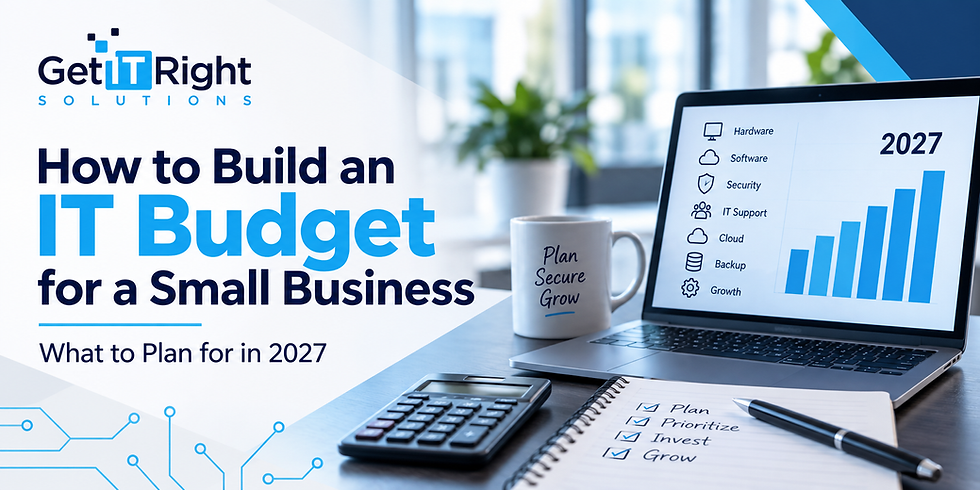
Businesses should also consider how unexpected technology problems affect their budgets. Get IT Right Solutions' article on building an IT budget for a small business provides additional context for planning technology investments.
How to Compare Managed IT Service Providers
Pricing should be part of the evaluation process, but it should not be the only deciding factor.
When reviewing providers, ask whether their agreements clearly define response expectations, cybersecurity responsibilities, monitoring coverage, backup services, and escalation procedures.
Also consider how providers handle growth. Will the agreement accommodate additional employees, locations, or cloud applications without requiring a complete restructuring?
Communication matters just as much as technical expertise. Your provider should explain recommendations clearly, identify potential risks, and help your organization understand upcoming technology expenses.
A provider that proactively maintains systems and supports long-term planning can deliver greater value than one focused primarily on resolving problems after they occur.
Get Predictable IT Support With Get IT Right Solutions
Managed IT services pricing should reflect more than the number of computers or employees in your organization. The right investment supports productivity, strengthens cybersecurity, reduces unexpected disruptions, and helps your business plan confidently.
At Get IT Right Solutions, we provide comprehensive managed IT support that includes responsive helpdesk assistance, proactive monitoring, cybersecurity, vendor management, and strategic technology guidance.
Our goal is to simplify IT management while giving businesses reliable support and predictable technology expenses.
Instead of managing multiple vendors or waiting for problems to interrupt operations, work with an experienced IT partner focused on keeping your technology running smoothly.
Contact Get IT Right Solutions to discuss your business's technology needs and request a customized managed IT services quote.


Comments